REVIEW · AKROTIRI EXCAVATIONS
Santorini: Experience Akrotiri with a Licensed Tour Guide
Book on GetYourGuide →Operated by DIMA GEORGIA · Bookable on GetYourGuide
You’ll walk a 4,000-year street fast. I love how this private Akrotiri tour starts at the site entrance with a licensed English guide, and I especially love the stop-by-stop explanation of the paved streets and squares plus the iPad photos of wall paintings that make ruined interiors feel real.
The main catch is the extra entrance cost: the tour covers your guide and private walking time, but you still pay the €20 per person site admission.
In This Review
- Key highlights worth planning for
- Meeting at Akrotiri’s entrance: the advantage of starting with a pro
- 70 minutes inside the prehistoric city: streets and squares you can actually follow
- Inside the buildings: 2–3 storeys, kitchens, toilets, and a drainage system
- Wall paintings and the Atlantis theory: where myth meets archaeology
- Timing and on-site logistics that make the visit feel easy
- Price and value: $198 for a private guide, plus the €20 entrance fee
- Should you book Akrotiri with a licensed guide?
- FAQ
- How long is the Akrotiri guided tour?
- Where do I meet the guide?
- Is the entrance fee included in the tour price?
- What language is the tour offered in?
- What should I bring, and what’s not allowed?
- Can I cancel for a full refund?
Key highlights worth planning for

- Licensed guide time on the ground at one of the world’s best-preserved prehistoric towns
- Skip-the-ticket-line start so you lose less time waiting
- Paved streets, squares, and drainage you can actually trace as you walk
- 2–3 story building layouts explained with what each room likely did
- Photos of original wall paintings that are hard to fully understand on-site
- Atlantis-style theories discussed with context so it stays grounded, not just hype
Meeting at Akrotiri’s entrance: the advantage of starting with a pro
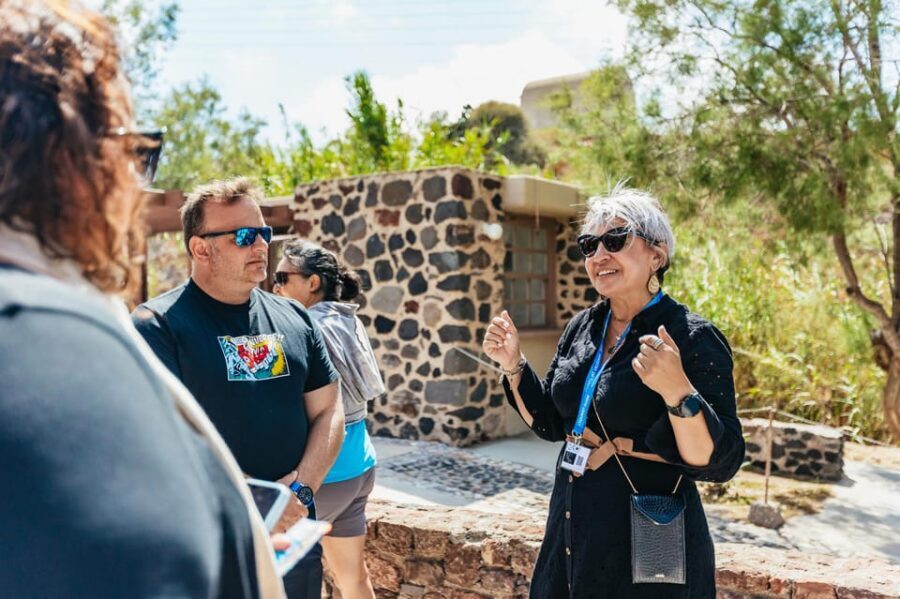
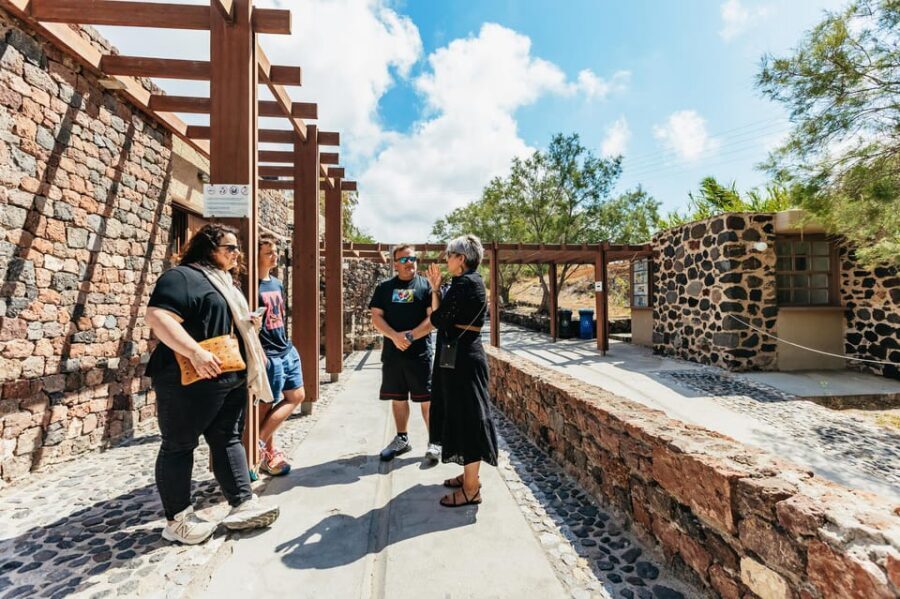
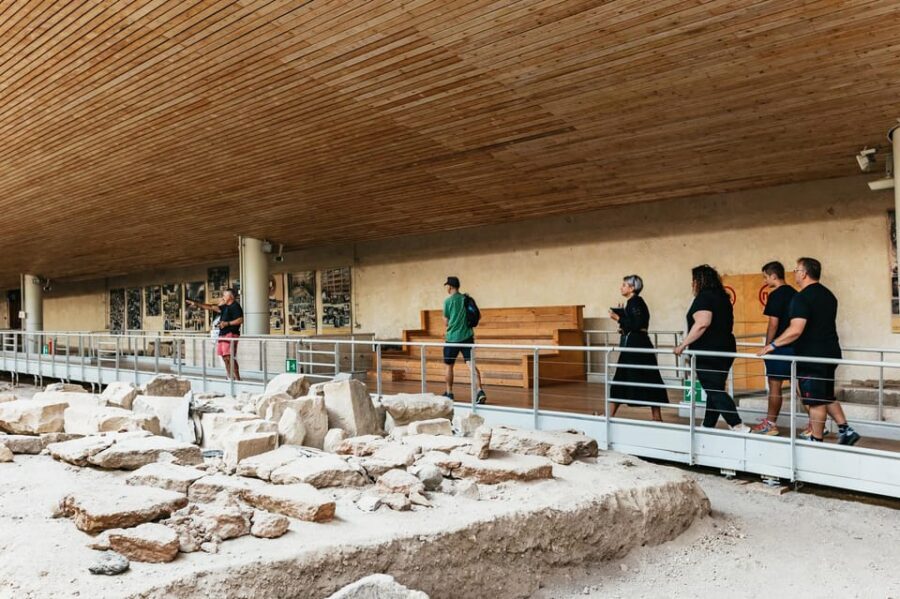
Akrotiri is one of those places where you can walk around and feel impressed, but still miss the point. The big win on this tour is how it begins: you meet your licensed guide right at the entrance, across from the cashier. That matters because the site is confusing at first glance—stone walls, different excavation levels, and ruins that were once fully functional buildings.
From the start, you’re not just collecting facts from signs. The guide keeps you moving with purpose, steering you from one building area to the next and explaining what you’re looking at. It also helps that this is a private group (so you’re not rushed, and you can ask questions as they come up). In a few reviews, the guide is discussed as someone with deep long-term experience at the site, including the ability to show supporting images on a tablet/iPad—so you’re not stuck guessing what a wall painting or interior once looked like.
You’ll also appreciate the practical touch: the tour includes skipping the ticket line, which is a real time-saver on an active island. And the tour is in English, so you’re not translating in your head while trying to enjoy the ruins.
Two small realities to keep in mind. First, this is an outdoor walking experience through a historic archaeological footprint, so wear comfortable shoes. Second, the tour runs about 70 minutes on the ground, with a total duration listed at 75 minutes, so it’s designed to be efficient rather than sprawling.
You can also read our reviews of more guided tours in Santorini



70 minutes inside the prehistoric city: streets and squares you can actually follow
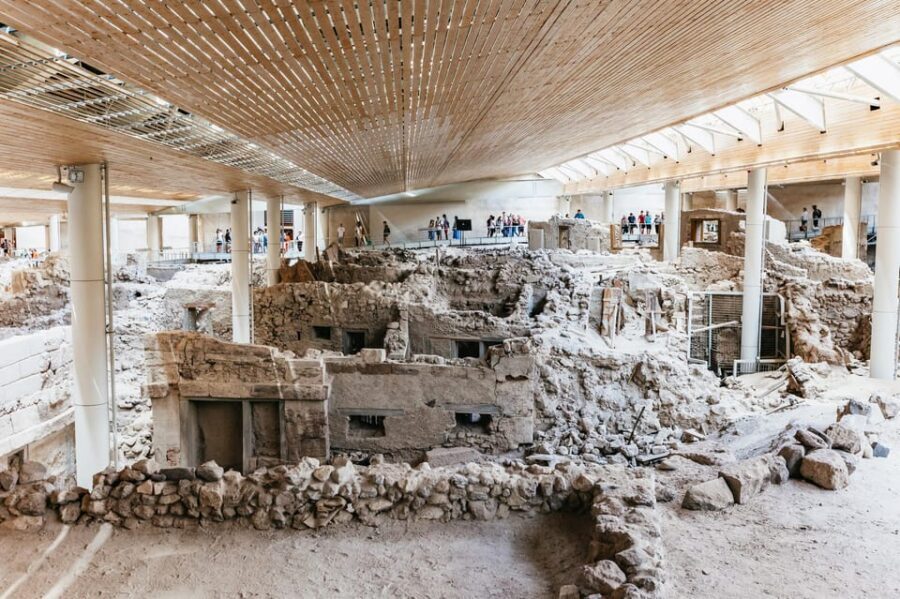
Once you’re in, the tour’s rhythm is simple. You walk the paved streets and through the squares, and the guide helps you read the town like a plan—not just a pile of stones. Akrotiri is famous because the settlement was buried by volcanic material after a major eruption (around 1600 B.C.), and that kind of burial is what helps preserve what you see today.
What makes guided time so valuable here is that Akrotiri’s layout is legible. You can point to where people lived, where rooms connect, and how movement through the town would have worked. Without guidance, you might mostly notice pretty walls or big building foundations. With a guide, the focus shifts to how the city worked as a community.
This is also where you’ll start picking up the difference between modern assumptions and Bronze Age reality. One review highlights how the tour helped correct misconceptions, noting Akrotiri isn’t simply a Minoan settlement in the way some visitors expect. That kind of clarity is part of the value: it turns the visit from sightseeing into understanding.
If you like a steady pace with breaks built in for questions, you’re in the right place. The private format makes it easier to stop and look longer at the spots that catch your attention, whether that’s a doorway alignment, a floor level, or the way a square opens up.
Inside the buildings: 2–3 storeys, kitchens, toilets, and a drainage system
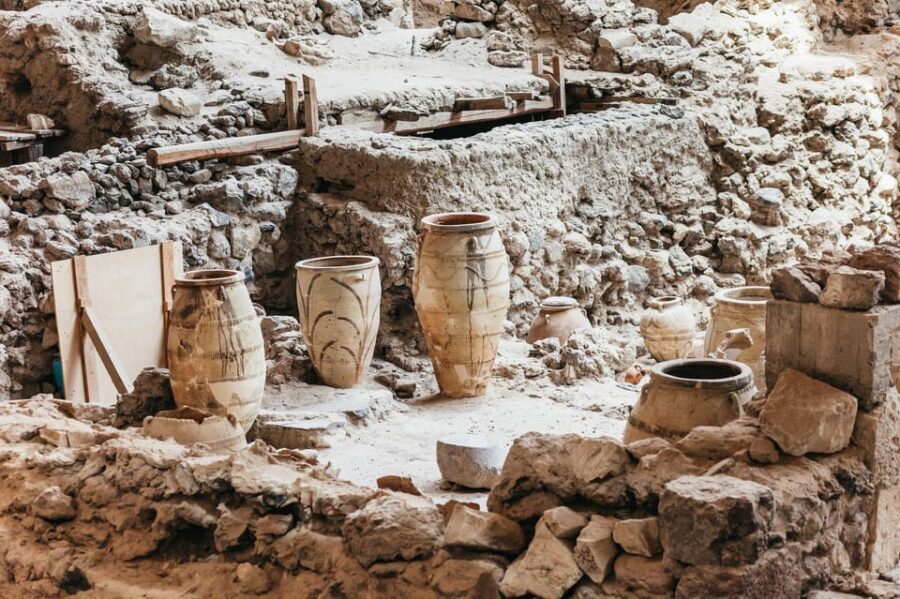
The heart of Akrotiri isn’t just that it’s old—it’s that you can see how people lived. The tour focuses on ruins that represent higher-building complexes (around 2–3 storeys) and explains what those levels likely meant for daily life.
You’ll spend time looking at building interiors and room functions, including references to kitchens and toilet facilities. You’ll also hear about infrastructure that feels surprisingly modern. One of the standout themes in the site details is the presence of a drainage system. That’s not a detail for trivia night. It changes how you picture the settlement. It suggests planning, sanitation thinking, and an organized way of handling waste and water—things that don’t happen by accident.
This is also where the guide’s photo support becomes practical. In the reviews, multiple people mention the guide showing images of original wall paintings that used to decorate buildings, because what’s on-site now can feel fragmentary. A tablet/iPad view helps you connect the preserved remnants to the broader decorative story that’s been documented and reconstructed through excavation.
And here’s the key takeaway for you: Akrotiri can look like a ruin maze if you treat it like a walk-through museum. The guide’s explanations give you a map in your head. Suddenly, rooms aren’t random. They’re functional spaces tied to routines.
Wall paintings and the Atlantis theory: where myth meets archaeology
One of the most fun parts of the tour is how it balances imagination with scholarship. As you move around, your guide shows photos of the original wall paintings that were once part of the interior decoration. That’s a major boost because wall art is often the first thing people want to understand, but it’s not always easy to reconstruct visually from the excavated surfaces alone.
From there, the tour also touches on theories that connect Akrotiri with the myth of the lost city of Atlantis. The point here isn’t to declare a winner in the myth debate. It’s to show you how catastrophic volcanic events can inspire stories, and how historians and archaeologists interpret evidence. That keeps the conversation interesting without turning it into pure legend.
If you’re the type who likes a clear thread—this happened, here’s what we can infer, and here’s what remains uncertain—you’ll probably enjoy this part. It gives you a narrative arc that keeps the ruins from feeling like disconnected “cool stones.”
If you’re not obsessed with ancient history, you still get something. Wall paintings and the Atlantis conversation work like story hooks. They pull you toward the human side of the site: what daily life looked like, what mattered enough to decorate, and how disaster reshaped a whole town in a very short time.
Timing and on-site logistics that make the visit feel easy
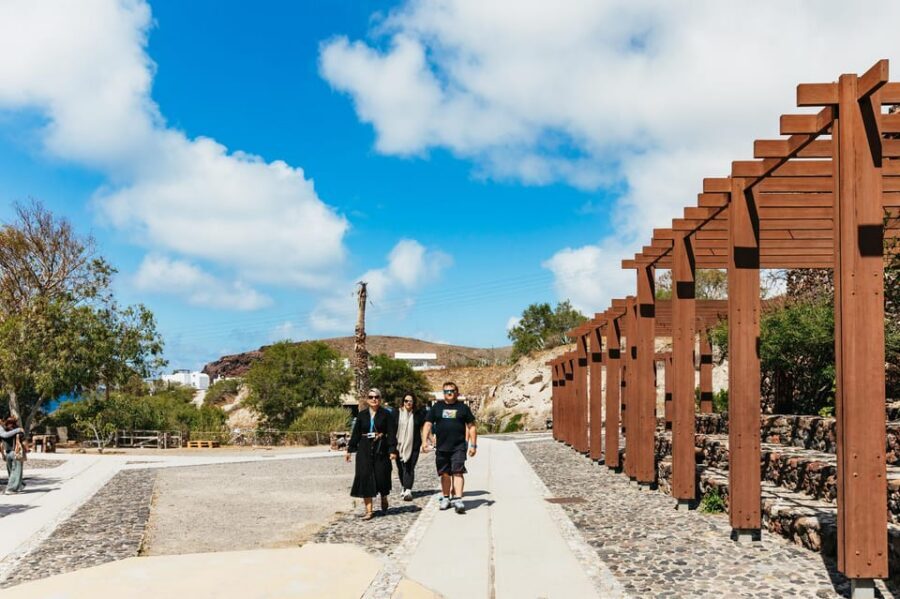
This experience is designed to keep friction low. You’re looking at a total of 75 minutes. That’s long enough to cover the core areas—streets, squares, and key building complexes—without turning Akrotiri into a half-day project.
Because you’re meeting the guide at the entrance, the start is straightforward. You also have skip-the-ticket-line built in, which can matter a lot when you’re visiting during busier hours.
The tour is listed as wheelchair accessible, so the route is set up for general access needs. The site is still a historic archaeological landscape, so you’ll want to move carefully and follow your guide’s pacing, but it’s good to see accessibility noted upfront.
As for what to bring, keep it simple: bring a camera. Food and drinks aren’t allowed during the experience, so plan to eat before or after. That also means you can stay focused on the ruins instead of timing snacks.
A practical planning tip from one of the reviews: I like the idea of visiting the Prehistoric Museum in Fira first if you have time. Even if you only do part of it, it helps you recognize what you’re seeing and connects artifacts and reconstructions back to the site.






Price and value: $198 for a private guide, plus the €20 entrance fee
Let’s talk money in a way that helps you decide. The tour price is $198 per group (up to 1) for about 75 minutes, and it’s private. That sounds like a lot until you compare it to the experience quality. In a private format, your guide can keep the pace comfortable, answer questions without rushing, and tailor explanations to your interests—especially helpful at a site where many features are subtle.
But there’s an important add-on. The €20 per person entrance fee is not included, so your total cost isn’t just the $198. If you’re booking solo, you’ll feel that more. If you can pair up with another traveler (or travel with a partner/family unit), you spread the group cost more efficiently, which matches what some reviews suggest about better value when more people share the private price.
So I’d frame the value like this: you’re paying for guided interpretation of a complex site, not just someone walking you from Point A to Point B. At Akrotiri, that interpretation is often the difference between looking at ruins and understanding how an advanced Bronze Age settlement functioned.
Who is this best for?
- You want more than placard reading and you like explanations that connect buildings to daily life
- You prefer private pacing and question time
- You’re visiting Akrotiri as a top-priority stop and want to feel confident you got the story
Who might want a different option?
- If you only want a quick walkthrough and you don’t care about architectural details, you might decide to self-guide
- If you’re very budget-tight and entrance fees add up, group tours can be cheaper
Should you book Akrotiri with a licensed guide?
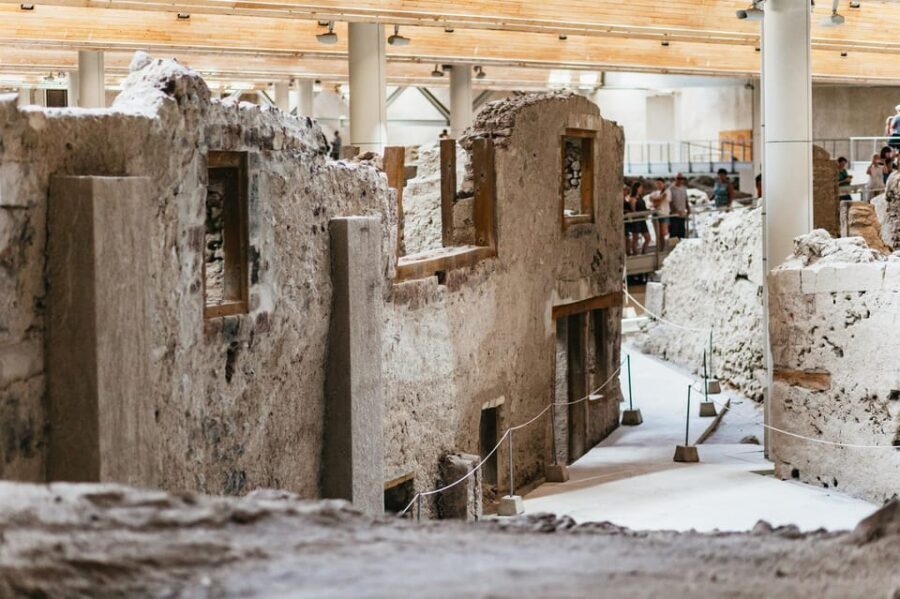
If Akrotiri is on your “must-see” list, I think this is an easy yes. The site is incredible on its own, but it’s also the kind of place where the value of a guide is obvious. You’re not just seeing ruins—you’re learning how a planned community worked: street layout, room functions like kitchens and toilets, and the drainage system.
The private format is a big part of why the experience tends to land well. You’ll get time to look closely, ask questions, and have the guide explain what the excavated pieces likely meant before the eruption froze daily life in time.
One more nudge: go in knowing there’s an extra €20 per person entrance fee. Once you accept that, the rest of the visit feels well-balanced—guided, focused, and built around the highlights you’d hope not to miss.
If you want Akrotiri to feel understandable, not just impressive, this is the way to do it.
FAQ
How long is the Akrotiri guided tour?
The activity is listed as 75 minutes total, with a guided walk of about 70 minutes on-site.
Where do I meet the guide?
Meet your guide at the entrance of the Akrotiri archaeological site, across from the cashier.
Is the entrance fee included in the tour price?
No. The tour price includes the guide and private tour time, but the entrance fee (€20 per person) is not included.
What language is the tour offered in?
The live tour guide offers English.
What should I bring, and what’s not allowed?
Bring a camera. Food and drinks are not allowed during the experience.
Can I cancel for a full refund?
Yes. There’s free cancellation up to 24 hours in advance for a full refund.