REVIEW · PRIVATE
Santorini, Designed By You: Your Private Island Masterpiece.
Book on Viator →Operated by Santo Luxury Escape · Bookable on Viator
Santorini goes from postcard to personal fast. This private island drive packs iconic viewpoints and real local stops into a tight 5 to 6 hours, with hotel or port pickup and live commentary. You’ll hit Oia for the big sunset mood, then keep moving around the caldera, beaches, and hilltop villages.
Two things I really like: the pacing is built for short, high-impact moments, and the guide setup (including pickup/drop-off and an A/C van) keeps you comfortable while the views do the heavy lifting.
One consideration: several stops are brief (10 to 30 minutes), so you’ll want comfy shoes and a camera that’s ready, because there’s not much time to linger like you would on your own.
In This Review
- Quick hits before you go
- Private Santorini in 5 to 6 hours: what makes this route work
- Oia sunset in the cliffs: blue domes, cave houses, and prime viewpoints
- Three Bells of Fira: postcard views in a tight 20 minutes
- Megalochori’s quiet alleys and the Akrotiri lighthouse cliff edge
- Red Beach to Perissa black sand: volcanic colors with real sea time
- Profitis Ilias monastery and Pyrgos: high views and old-village streets
- Akrotiri archaeological site and Faros Market: time travel plus real tastes
- Windmills of Emporio, Wine Museum, and Ftelos Brewery: optional sips and a full-flavor finish
- Wine Museum Koutsogiannopoulos
- Ftelos Brewery Santorini
- The guide experience: organization, photo help, and how to get the most
- Price and what’s included: where your money goes
- Who should book this Santorini private tour
- Should you book Santo Luxury Escape’s Santorini route?
- FAQ
- How long is the Santorini private island masterpiece tour?
- What’s included in the price?
- Does the tour include entrance fees?
- Is this a private tour or shared group?
- Do you offer pickup?
- Is there free cancellation?
Quick hits before you go
- Private van + door-to-door pickup from hotel, port, or airport, so you spend less time hunting transportation.
- Oia sunset timing works well if you choose an afternoon departure for that classic caldera glow.
- A smart mix of famous and local-feeling villages, like Megalochori and Pyrgos, not just the usual photo stops.
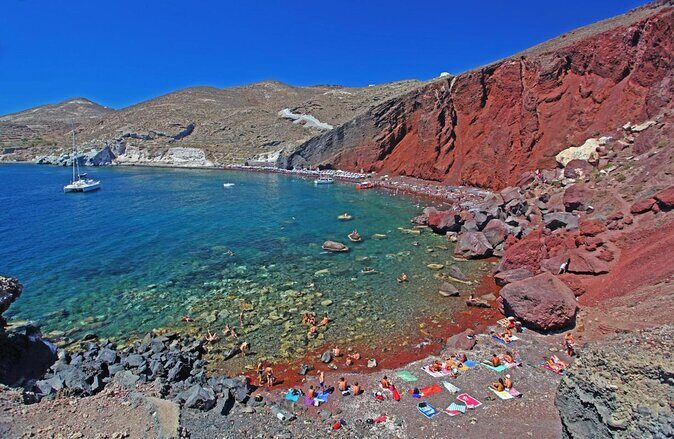
- Volcanic coast variety: red beach one moment, then Perissa’s black sand and swimming water.
- Optional paid experiences (Akrotiri, wine museum, brewery) let you choose how much time and money to spend on tastings and history.
- Nikos is a standout guide name in the feedback, praised for organization and even helping with photos.
Private Santorini in 5 to 6 hours: what makes this route work
Santorini is small on a map, but the roads climb and curve like someone drew them with a ruler and a grudge. This tour is designed to reduce decision fatigue. You get a deluxe, air-conditioned van, pickup and drop-off, bottled water, and live commentary so you don’t waste time figuring out what’s where.
The itinerary also respects your time. Oia gets a longer window, while other stops are intentionally short: quick viewpoint moments, photo angles, and a chance to step into a village before the next viewpoint opens up. If you’re the kind of traveler who hates “we’ll just drive past it,” this style should feel right.
Price-wise, $278.16 per person isn’t “cheap,” but it’s built around convenience and access. You’re paying for private transportation, a local driver/guide, and the flexibility of a route that doesn’t require you to stitch together buses and cable cars.
One more practical note: this is listed as offered in English, and it’s a private tour where only your group participates. That matters because you can ask for quick adjustments as long as they fit the overall schedule.
You can also read our reviews of more private tours in Santorini


Oia sunset in the cliffs: blue domes, cave houses, and prime viewpoints

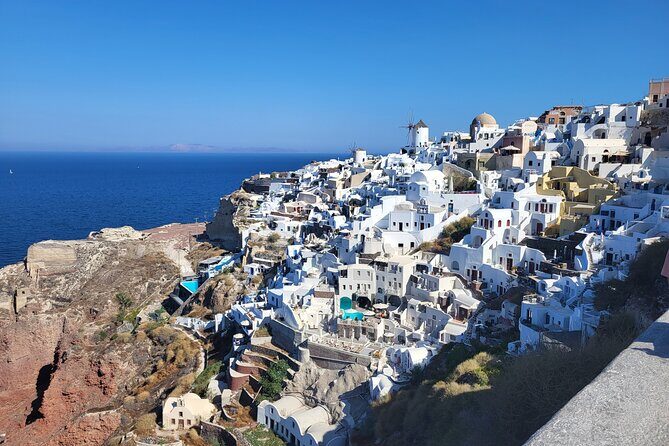
Oia is Santorini’s camera star. You’ll spend about 45 minutes there, with the big moment available if you choose an afternoon departure. From the village you get that signature view over the caldera, plus the feel of walking stone paths above the sea.
Here’s what to look for when you’re there:
- Blue-domed churches and marbled paved walkways that funnel you toward the best sightlines.
- Open-air cafes, restaurants, art galleries, and shopping areas, so you can stop for a drink or snack even if you’re not buying souvenirs.
- Maritime museum vibes and traces of Venetian fortress history, plus the captains’ houses—Santorini’s old wealth still shows in the architecture.
- Cave houses used by ship crews, which add a more textured layer to the village story than the photos alone.
The trick in Oia isn’t to see everything. It’s to pick one direction and walk slowly enough to let the light change. If sunset is your goal, prioritize viewpoints that face west, and give yourself enough time to stand still. The best photos usually come from waiting a few minutes, not from sprinting for the next angle.
Drawback: Oia is popular, and this tour gives you limited time. If you want a long sit-down meal or a slow wander with zero time pressure, you’ll feel the “on to the next stop” rhythm.
Three Bells of Fira: postcard views in a tight 20 minutes
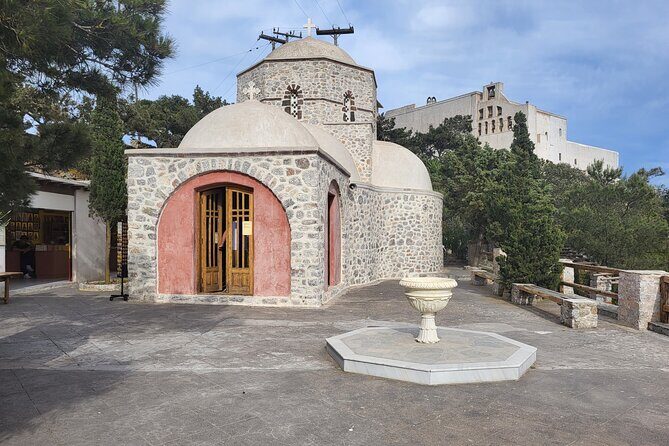
After Oia, you’ll swing over to Fira’s rim area for the Three Bells of Fira. The stop is about 20 minutes—short, but it’s timed for maximum payoff.
This is one of those places where the famous symbol does the work for you:
- You’re in the older style village area, often called the crown of Fira.
- From the scenic balcony you can look outward at the caldera.
- The three bells and blue-domed church are the elements that show up on postcards because they genuinely hold up in real life.
What you should do with your 20 minutes: take a couple of photos, then step aside and look for the angle where the cliffs and sea line up. The best viewpoint isn’t always the first one you spot. A quick walk of just a few steps can totally change what the caldera looks like.
Drawback: since the stop is brief, this is not the moment for deep sightseeing. Use it to collect images and orientation.
Megalochori’s quiet alleys and the Akrotiri lighthouse cliff edge

Megalochori is a different mood. You’ll have around 20 minutes here, and the feel is intentionally calmer than the most photographed towns. The settlement is made of small white-painted houses, tiny alleys, and tower bells, with blue-domed chapels appearing between the curves of the streets.
What makes it worth your time:
- The architecture and layout feel lived-in, not staged.
- You can spot underground cave houses, which tell you how Santorini used space wisely.
- It’s described as non-touristic, so you’re more likely to experience the village as a place where people live, not only where you visit.
Next comes the Akrotiri Lighthouse, another short stop at about 20 minutes. The lighthouse itself was built by a French company in 1892, and it’s known for being a great sunset watch spot.
The positioning matters. It’s right on a high cliff above the sea, so you get panoramic views of the caldera from a different angle than Oia. If Oia is “classic Santorini,” Akrotiri lighthouse is “Santorini with a wider lens.”
Drawback: these are both brief, so wear shoes you can trust on uneven stone and don’t plan on reading every sign. Your goal is to take in the layout and get the view, then move.
Red Beach to Perissa black sand: volcanic colors with real sea time
You’ll see two very different beaches back-to-back: Red Beach (about 10 minutes) and Perissa Black Sand Beach (about 10 minutes).
At Red Beach, the key is the color and geology. Red is the dominant tone, and the volcanic rocks plus steep hills create a wild, dramatic scenery that grabs your attention fast. Even if you don’t swim, the rock formations make for strong photos because they contrast with the sea.
Then you head to Perissa, which is described as the longest and most famous black sand beach. The black lava sand is the signature, but the practical win is that it’s also a place you can actually enjoy for a short swim. The waters are described as crystal clear, and seaside restaurants offer traditional dishes—just remember food and drinks are not included unless specified.
How to make this portion worth it: since time is short, decide whether you want photos only or a quick dip. If swimming matters, bring a swimsuit you can change into quickly. If photos matter more, stick around just long enough to catch the sand texture and sea color.
Drawback: 10 minutes is not enough for a long beach day. Think of it as a taste of the coast rather than a full relaxation stop.





Profitis Ilias monastery and Pyrgos: high views and old-village streets

The tour climbs again for two village experiences that are both scenic but very different.
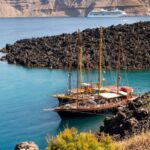
First is the Monastery of Profitis Ilias. You’ll spend about 15 minutes at one of the island’s highest points. This stop is all about the view—past the cliffs, over the island, and across the caldera. The monastery is tied to the name Prophet Elias (Profitis Ilias), and it’s said the monastery was built in 1711.
There’s also a small food-and-drink angle here. You may be able to taste wine and local products made by the monks, which is a rare way to connect the view with a local tradition instead of treating it as just another lookout.
Then you’ll head to Pyrgos, the island’s oldest village, where you’ll get about 30 minutes. Pyrgos is known as a historic monument area built on a hill, with a 16th-century Venetian castle. Wandering here feels more like walking through a place that holds its own shape: small alleys, circle-shaped roads, vineyards, and narrow cave houses with balconies.
In practice, Pyrgos is a great place to slow down. You’re not fighting for the same crowd energy as the most famous viewpoints. It’s also a strong photo stop because the streets and pebbled paths create depth.
Drawback: if you hate heights, these climbs can feel intense. If you’re sensitive to steep steps or uneven ground, plan for short breaks and steady pacing.
Akrotiri archaeological site and Faros Market: time travel plus real tastes
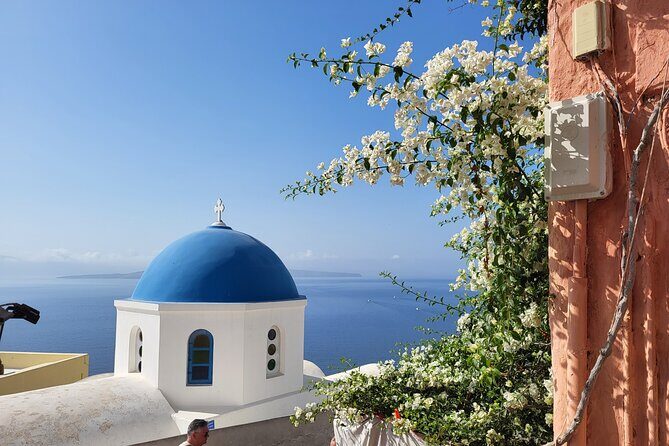
This part adds both depth and flexibility.
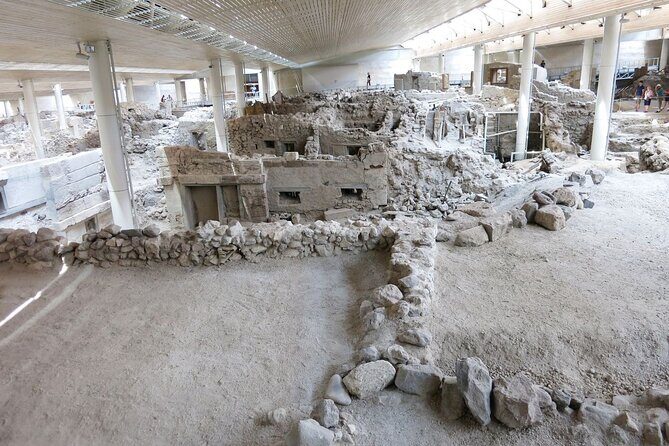
At Akrotiri Archaeological Site, you’ll spend about 30 minutes, and this is a paid entrance (€20 per person, not included). Akrotiri is described as a 4000-year-old Bronze Age settlement that thrived for centuries before being erased by a volcanic eruption. The ash burial is why the artifacts and frescoes survived, which turns this into more than a dramatic story—it’s a rare chance to see how ancient life was laid out.
What you can expect to notice quickly (even in 30 minutes):
- Ancient walls and remnants of a town with 3-story buildings
- Well-preserved frescoes
- An elaborate drainage system
Then comes Faros Market, in the suburbs of Akrotiri, with about 10 minutes. This is where the tour turns from sightseeking to sampling.
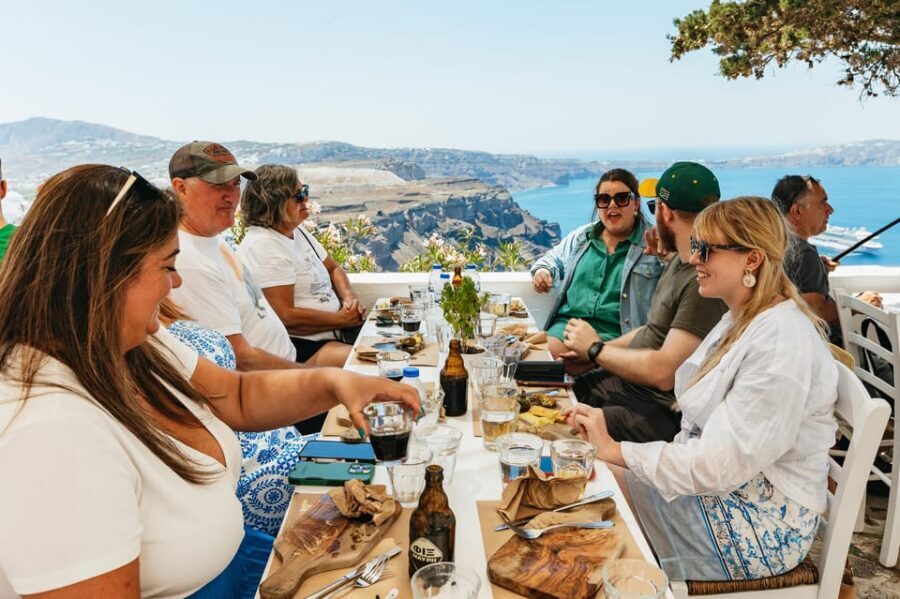
Faros Market is built around a family farm where you can taste homemade wine and local products made without preservatives or chemical additives. You might try things like fava, sun dried tomatoes, capers, olive paste, and traditional sweets. There’s also a wine cellar and a grape-stomping tank, which adds context to what you’re tasting so it doesn’t feel like random shopping.
Drawback: both stops are short. If you’re the type who loves museums and wants to read every label, Akrotiri may feel rushed. If your goal is “see the essentials and keep moving,” this is a good fit.
Windmills of Emporio, Wine Museum, and Ftelos Brewery: optional sips and a full-flavor finish
The last stretch leans into Santorini’s edible side.
First, you’ll stop at Windmills of Emporio for about 20 minutes. You’ll walk along a small road toward the hilltop with views of 8 traditional windmills and an isolated whitewashed chapel on the edge of the cliff. This is a strong photography moment because it gives you a clear horizon line, and it’s noted as suitable for panoramic shots and even sunset views.
Next, the itinerary offers two paid indoor experiences:
Wine Museum Koutsogiannopoulos
At the Wine Museum Koutsogiannopoulos, the visit is about 1 hour, and admission is €25 per person (not included). It’s set in a natural cave about 300 meters long, with maze-like corridors. The tour includes a tasting in a specially designed room. The museum focuses on Santorini wine production history from 1660 to 1970.
If you like stories you can taste, this is worth the fee. The cave setting also helps make it feel like more than a quick shop stop.
Ftelos Brewery Santorini
Then there’s Ftelos Brewery Santorini for about 1 hour, also €20 per person (not included). This isn’t just a beer bottle viewing. You get a guided tour with a mini seminar about how beer is brewed. The production area is visible from the taproom through glass, so you can watch the brewing unit, control panel, fermentation and aging tanks, and even parts of the bottling and filtering process.
The end is tasting: six artisanal beers, plus a snack described as luxurious. It’s a fun way to finish a day where you’ve seen so much coastline and architecture.
One more thing: the guide, named Nikos in multiple accounts, is repeatedly praised for making the day feel organized and enjoyable. In at least one account, he arranged small side moments like access to a friend’s shop even when it wasn’t open normally, so you could sample farm-made items such as wines, jellies, and capers. That kind of flexibility can turn a good tour into a memorable one, so it’s worth asking Nikos if there’s time for a little extra sampling where it makes sense.
Drawback: these paid stops cost extra, and they also take time. If you’re not into wine or beer, you might feel like you’re paying for something you don’t care about.
The guide experience: organization, photo help, and how to get the most
This tour is built around a local driver/guide plus live commentary. That matters because Santorini’s highlights can blur together if you don’t have someone connecting the dots: why Oia’s layout looks the way it does, what cave houses meant, and why the eruption shaped everything from beaches to architecture.
In the feedback, Nikos is called out for being well organized and great company, with a clear plan that still gave people ample time at stops. One review also mentioned that he served as a photographer for the day, which is practical if you don’t want to keep asking strangers to take your picture.
Here are simple ways you can get more value from that setup:
- Tell your guide what you care about: sunset photos, beaches, ancient history, or tastings.
- Ask for one or two specific photo angles instead of trying to crowd the best spot yourself.
- If you’re trying to catch sunset, choose your Oia direction quickly and commit to it.
Also, you’re in a private tour. That’s a quiet advantage. You’re not competing for attention, and your guide can keep the flow moving without waiting on other groups.
Price and what’s included: where your money goes
At $278.16 per person, you’re paying for more than sightseeing. Your price covers:
- Private transportation in an air-conditioned deluxe van
- Experienced local driver/guide and live commentary
- Bottled water
- Maps
- Hotel/port/airport pickup and drop-off
- A mobile ticket
- Group discounts are noted, and it’s a private group experience
Then you have what you’ll pay separately:
- Akrotiri Archaeological Site entrance: €20 per person (not included)
- Wine Museum Koutsogiannopoulos: €25 per person (not included)
- Ftelos Brewery Santorini: €20 per person (not included)
- Cable car tickets: €10 per person per ride for cruise ship travelers (not included)
So the value question becomes: do you want history plus tastings? If you say yes, the extra fees line up with the tour’s “experiences” portion. If you say no to museums and brewery, you’ll still see a lot of Santorini, but you might feel like some of the itinerary is angled toward people who enjoy wine and beer.
A nice thing for planning: everything at the paid stops is time-boxed. You’re not wandering around until you remember you should’ve bought tickets earlier.
Who should book this Santorini private tour
I’d put this in the sweet spot for people who want:
- A guided day with minimal logistics (pickup, A/C van, and live commentary)
- Classic Santorini highlights plus quieter villages like Megalochori and Pyrgos
- A route that mixes viewpoints with actual stops, not just a fast bus tour
- Flexibility to enjoy optional tastings at your pace
You might want a different style if:
- You want a slow beach day with lots of time to lounge
- You prefer doing ancient sites at your own speed and reading everything
- You don’t drink wine or beer and don’t want paid add-ons
Should you book Santo Luxury Escape’s Santorini route?
Yes, if you’re visiting Santorini for the first time and want the day to feel intentional. This route gives you the big names—Oia sunset energy, Fira’s Three Bells, red and black beaches, plus Pyrgos and Akrotiri—without forcing you to plan transport between them. The private setup also means you’re not stuck waiting behind other groups.
Before you book, think about two things. First, can you handle short stops with quick photo moments? Second, are you okay with paying extra for Akrotiri (€20), the wine museum (€25), and the brewery (€20) if you choose to do them all.
If your answers are yes, you’ll likely enjoy how the day flows from cliff viewpoints to volcanic beaches to hilltop villages, with a guide like Nikos helping keep it organized and fun.
FAQ
How long is the Santorini private island masterpiece tour?
It runs about 5 to 6 hours.
What’s included in the price?
The tour includes bottled water, an experienced local driver/guide, private transportation in an air-conditioned deluxe van, maps and live commentary, plus hotel/port/airport pickup and drop-off.
Does the tour include entrance fees?
Not all entrances are included. The Akrotiri Archaeological Site (€20), Wine Museum Koutsogiannopoulos (€25), and Ftelos Brewery (€20) are listed as not included.
Is this a private tour or shared group?
It’s a private tour/activity, so only your group participates.
Do you offer pickup?
Yes. Hotel/Port/Airport pickup and drop-off is included.
Is there free cancellation?
Yes, you can cancel for a full refund up to 24 hours in advance of the experience start time.